The scale is moving. Your strength shouldn’t be what goes with it.
When the stairs get harder as the weight comes off, it may not be your age. A 2026 review of 20 randomized trials found that a quarter or more of the weight lost on these medications can be lean mass. The same review pointed to protein and strength work as the way to hold on to it.
Keep Your Muscle on a GLP-1 After 50
The Strength-Guard Method
The Strength-Guard Method is a free printed book that shows you how, from the meals you already eat and a chair already in your room. No gym. No diet. Nothing to count.
- ✓Guard 1, Protein first: protein in the first few bites, before fullness sets in
- ✓Guard 2, Strength from a chair: two short sessions a week, starting from a chair
- ✓Nine short chapters, in the order you'll use them
Step 1 of 3 · Your Details
Your Free Book Starts Here
Keep Your Muscle on a GLP-1 After 50
The Strength-Guard Method
Book: FREE · Shipping: $12.95
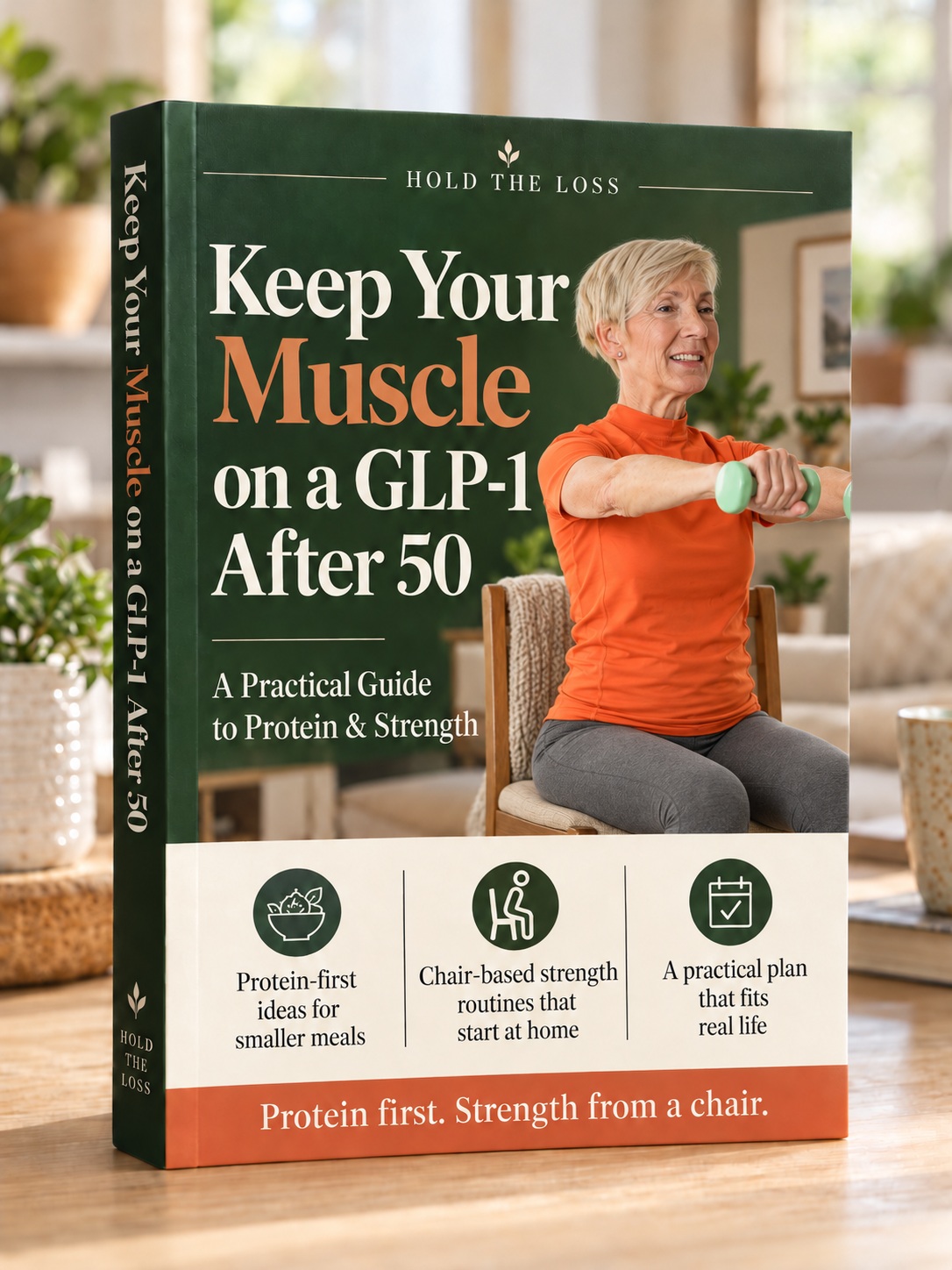
By M. R. Calloway (pen name). Education, not medical advice.
Why the Stairs Can Get Harder Even as the Scale Goes Down
Many people over 50 notice it a few months in.
The scale is finally moving. The clothes fit differently. And yet the stairs take a little more effort than they used to. Getting up from a low chair takes a push. The grocery bags feel heavier on the walk from the car.
Most people put it down to age.
Here’s the part most people aren’t told: when weight comes off, not all of it is fat.
In a 2026 review of 20 randomized clinical trials with 15,782 participants, 25% to 39% of the weight lost on these medications was lean mass. That’s about the same share as with diet changes alone. (Lean mass also includes water and organ tissue, so true muscle loss is lower.)
The same review had good news. In trials that paired lifestyle changes with strength training, the share of lean mass lost was about 17.5%. The authors point to strength work and enough protein as the way to hold on to muscle.
So if the stairs feel harder, it may not be your age. And it’s something that can be worked on, starting this week.
Source: Eisa & Barood, “Lean Mass Changes With Incretin Therapy Versus Lifestyle Intervention: A Systematic Review and Meta-Analysis of Randomised Controlled Trials,” Diabetes, Obesity and Metabolism, 2026.
These are group-level research findings, not results from testing this book. Individual results vary.
Why “Eat More Protein and Lift Weights” Is Harder Than It Sounds
You’ve probably heard the advice. It’s not wrong. It just wasn’t written for this stage.
- “Eat more protein.” Hard to do when half a plate already feels like plenty.
- “Lift weights.” Hard to start when the gym feels like someone else’s place, or the knees have opinions.
- “Track it in an app.” One more thing to log, on top of everything else.
None of this is a willpower problem. The usual advice was written for bigger appetites and younger knees.
Meet the Strength-Guard Method
The weight is coming off. Nothing is guarding the strength. That’s the gap this book fills, with two small moves.
Guard 1: Protein first
In the first few bites of the meals you already eat, before fullness sets in. Familiar foods, grouped by what matters most, without bigger portions.
Guard 2: Strength from a chair
Two short sessions a week that start with standing up from a chair. Bands and light weights come later, when you’re ready, not before.
Same foods. Same home. A plan that fits a smaller appetite and a body that’s changing.
Why a printed plan, not another search
You can look up protein and strength anywhere. What’s hard is knowing what to do first, in what order, at your stage. This book puts one plan in one place: what to eat first, how to start from a chair, and a one-page routine for the fridge door.
Two Pages From the Book You Can Try This Week
Guard 1 · The Few-Bites Shelf
Keep two or three of these where you’ll see them: eggs, Greek yogurt, cottage cheese, canned tuna or salmon, cooked chicken, tofu, lentils. At your next meal, start with two or three bites of the protein, before anything else on the plate. Same meal, different order.
Guard 2 · The First Chair Move
Sit near the front of a sturdy chair, feet flat. Lean forward a little and stand up, using your hands on the chair or your knees if you like. Sit back down slowly. Do a few, rest, and do a few more. That’s where the routine starts.
Everyone’s needs are different. Check with your doctor before starting new exercise, and before eating more protein if you have kidney disease or have been told to limit protein.
What’s Inside: Nine Short Chapters, in the Order You’ll Use Them
The Strength-Guard Method, in nine short chapters.
- 1
It May Not Be Your Age: what can come off along with the weight, and why it matters after 50
- 2
The First Few Bites: why the order you eat in matters more when appetite is small
- 3
The Small-Plate Protein Shelf: foods that fit a smaller appetite
- 4
Breakfast, Lunch, Dinner, Snack: protein-first swaps for the meals already on your table
- 5
Start From a Chair: your first strength session, and your second
- 6
When to Add a Band (and When to Wait): the signs it's time to progress
- 7
Two Sessions in the Week You Already Have: where they fit, and what to do when a week goes sideways
- 8
If the Dose Changes or Stops: what to keep doing, so the habits don't depend on the medication
- 9
Questions for Your Next Appointment: a fill-in page to take to your doctor or prescriber
Plus a one-page routine for the fridge door.
Your first week: how to tell it’s working
Day 1
Stand up from a chair and notice how it feels. That's your starting point.
Day 3
Protein first at two meals. One chair session.
Day 7
Stand up from the same chair. Notice what feels easier, and keep it.
No need to get every day right. The goal is a routine that fits.
The Point Isn’t the Protein. It’s the Stairs, the Suitcase and the Grandkids.
Protein and chair sessions are the how. The why is the everyday life around them: carrying the groceries in one trip, the stairs at a friend’s house, lifting the carry-on into the overhead bin, getting down on the floor with the grandkids (or the dog) and back up again.
That’s what this book is built to help you protect, because you still have places to go.
And if you’ve never thought of yourself as a gym person, good. This doesn’t start in a gym. It starts in a chair.

Written for Adults Over 50 Whose Weight Is Coming Off and Whose Strength Still Matters
- Adults over 50 taking a GLP-1 for weight loss, or going through a dose change
- People whose appetite is smaller, for whom getting enough protein feels like a chore
- Anyone who'd like to get stronger at home, without a gym
- Readers who'd rather have a printed book than another app or membership
What This Book Is Not
Not another weight-loss diet. Not an intense fitness challenge. Not a replacement for medical care, a personal meal plan or supervised exercise. And it doesn’t promise a particular amount of muscle kept or strength gained. It’s a practical, research-informed guide to the next useful steps.

Why It’s Free, and Why It’s on Paper (Not Another App)
There’s already plenty of general advice about protein and exercise. What’s harder to find is the sequence: what to do first, on a smaller appetite, after 50. That’s what this book is, on paper, in order, so it can sit on the kitchen counter.
We’d rather get the first printing into the kitchens of people who’ll use it. So the book is free. You just cover the $12.95 it costs us to print and mail it to you. No subscription, nothing to cancel.
Here’s Exactly What You’ll Receive
Keep Your Muscle on a GLP-1 After 50, the printed nine-chapter guide to the Strength-Guard Method, with:
- Both guards: Protein first and Strength from a chair
- Nine short chapters, plus a fill-in page for your next appointment
- A one-page routine for the fridge door
Plus your gift: the 7-Day Starter Plan by email.
Your Order
Total: $12.95
No subscription · Nothing to cancel · U.S. addresses only
Written by M. R. Calloway (pen name). Published by Hold the Loss.
Frequently Asked Questions
About the author
M. R. Calloway is a pen name. The book was written and published by an independent researcher who spent months reading the clinical evidence on muscle loss during weight loss, and wrote the plan he couldn’t find. Education, not medical advice. Talk to your doctor before changing your diet or exercise.
The Progress Already Made Is Worth Building On
Protein first, in the meals you already eat. Strength work that starts from a chair. A free printed book for life after 50, because you still have places to go.
Free printed book · $12.95 shipping
P.S. The weight is coming off. The Strength-Guard Method is how you keep what matters: a free printed book that puts protein first in the meals you already eat and starts strength work from a chair at home, no gym needed. The book is free; you cover the $12.95 it costs to print and mail it.